Head-to-head comparison · Fish Finders
Humminbird HELIX 7 MEGA DI vs Garmin STRIKER Vivid 7cv
Two 7-inch fish finders with CHIRP, down imaging and GPS. The Humminbird has a sharper screen, MEGA Down Imaging and a preloaded basemap; the Garmin reaches deeper and has Wi-Fi.
By Outdoor Spec Desk Editorial· Updated
This page was drafted with AI assistance from manufacturers' specs and manuals, and is checked by our editor.
Why the Humminbird HELIX 7 CHIRP MEGA DI GPS G4N wins
For most bass and walleye anglers on inland lakes, the HELIX's 1024 x 600 screen, MEGA Down Imaging and preloaded Humminbird Basemap give more detail and a map out of the box. Choose the Garmin for deep water and Quickdraw Contours mapping.
Prices change often. Check the current price and availability on Amazon.
Check Latest Price on Amazon (paid link)Humminbird HELIX 7 CHIRP MEGA DI GPS G4N
A 7-inch, 1024 x 600 fish finder with Dual Spectrum CHIRP, MEGA Down Imaging, GPS, Humminbird Basemap and NMEA 2000 networking.
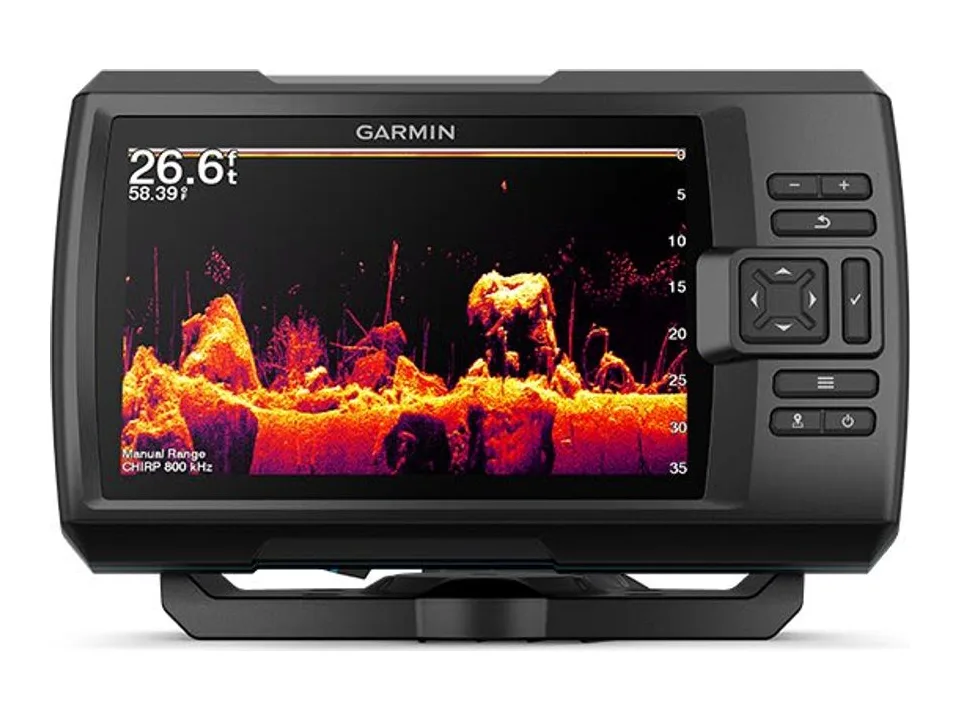
Garmin STRIKER Vivid 7cv
A 7-inch CHIRP and ClearVü fish finder with built-in GPS, Quickdraw contour mapping and Wi-Fi, sold with the GT20-TM transducer.
Side-by-side
Specs compared
| Specification | Humminbird HELIX 7 CHIRP MEGA DI GPS G4NOur pick | Garmin STRIKER Vivid 7cv |
|---|---|---|
| Editorial score | Editorial score:8.6/10 | Editorial score:8.9/10 |
| Best for | Best Down Imaging Detail | Best 7-inch Down Imaging |
| Type | Fish finder with GPS | Console fish finder with GPS |
| Screen | 7 in diagonal, color TFT | 7.0 in diagonal, WVGA color |
| Resolution | 1024 x 600 pixels | 800 x 480 pixels |
| Sonar | Dual Spectrum CHIRP plus MEGA Down Imaging (125 ft) and 455 kHz Down Imaging (350 ft) | Traditional 50/77/200 kHz, CHIRP (mid and high), ClearVü 260/455/800 kHz |
| Transmit power | 500 W (RMS) | 500 W (RMS) |
| Transducer included | XNT 9 HW MDI 75 T (transom mount) | GT20-TM (transom mount) |
| Max depth (traditional) | 1,200 ft with the standard transducer | 1,900 ft with the GT20-TM |
| GPS | Built-in | Built-in, WAAS |
| Mapping | Humminbird Basemap | Quickdraw Contours (you create the map) |
| Wi-Fi / app | Bluetooth; Ethernet and NMEA 2000 networking | Yes, Garmin Wi-Fi network |
| Waypoints | — | 5,000 |
| Water rating | — | IPX7 |
| Weight | — | 1.7 lb (770 g) |
| Dimensions | — | 9.3 x 5.5 x 2.3 in |
| Where to buy | Check Latest Price on Amazon (paid link) | Check Latest Price on Amazon (paid link) |
Scroll sideways to see both columns →
At a glance
Key differences
- 1Screen: 1024 x 600 against 800 x 480
- 2Down imaging: MEGA Down Imaging (to 125 ft) plus 455 kHz against ClearVü 260/455/800 kHz
- 3Max depth (traditional): 1,200 ft against 1,900 ft
- 4Maps: preloaded Humminbird Basemap against Quickdraw Contours (you create the map)
- 5Transmit power: 500 W (RMS) for both
Product by product
Pros and cons
Humminbird HELIX 7 CHIRP MEGA DI GPS G4N
The sharpest 7-inch screen we cover and very detailed down imaging, with room to grow into a networked system. If you do not need down imaging, the HELIX 7 CHIRP GPS G4N does the rest.
Pros
- 1024 x 600 screen, sharper than the 800 x 480 panels on the other 7-inch units we cover
- MEGA Down Imaging for detailed pictures of structure down to 125 ft
- Humminbird Basemap preloaded
- Ethernet and NMEA 2000 for adding units and accessories later
Cons
- No side imaging; that needs the HELIX 7 MEGA SI model
- MEGA Down Imaging works to 125 ft, so deep-water anglers rely on the 455 kHz setting or 2D sonar
- Humminbird does not list a water rating or weight on the pages we read
Garmin STRIKER Vivid 7cv
The STRIKER Vivid 7cv is the one to get if you fish from a small boat and want a screen big enough to read sonar at a glance. Choose the 5cv instead if console space is tight, and look elsewhere if you need side imaging or preloaded charts.
Pros
- The 7-inch screen leaves room for a split sonar and ClearVü view without squinting
- Built-in GPS and Quickdraw Contours let you build your own 1-foot contour maps of lakes with no charts
- Wi-Fi is included, which the 4cv and 5cv lack
- The bundled GT20-TM transducer covers traditional CHIRP and ClearVü down-scan
Cons
- No SideVü side-scan: you need the 7sv and a different transducer for that
- No preloaded lake charts; mapping is what you record yourself
- Larger and heavier than the 5cv, so it is a tighter fit on a kayak console
Choose the Humminbird HELIX 7 CHIRP MEGA DI GPS G4N if
- You want the sharper screen and MEGA Down Imaging detail.
- You want a map on the unit from day one.
- You may network units later: Ethernet and NMEA 2000.
Choose the Garmin STRIKER Vivid 7cv if
- You fish deep water: 1,900 ft traditional sonar with the GT20-TM.
- You want to build your own contour maps with Quickdraw.
New to the terms? See CHIRP vs down imaging vs side imaging.
Frequently asked questions
- Which has the sharper screen?
- The Humminbird HELIX 7, at 1024 x 600 against 800 x 480 for the Garmin STRIKER Vivid 7cv.
- Does the Garmin STRIKER Vivid 7cv have maps?
- It has Quickdraw Contours, which builds maps as you fish; it does not come with preloaded charts.
- Which reads deeper water?
- The Garmin, rated to 1,900 ft in traditional sonar with the GT20-TM, against 1,200 ft for the HELIX 7 with its standard transducer.
Sources
The specifications and claims on this page come from these manufacturer documents. Figures are the manufacturers' own unless the text says otherwise.
More comparisons
VS comparison
Humminbird HELIX 7 CHIRP GPS G4N vs Humminbird HELIX 7 CHIRP MEGA DI GPS G4N
Same 7-inch, 1024 x 600 screen, GPS, Basemap and networking. The MEGA DI model adds down imaging through a different transducer.
Updated October 15, 2026
VS comparison
Garmin STRIKER Vivid 7sv vs Garmin STRIKER Vivid 7cv
The 7sv and 7cv share the same 7-inch screen, body, weight and transmit power. The 7sv adds SideVü side imaging, a second transducer port and a different transducer.
Updated October 14, 2026
VS comparison
Garmin STRIKER Vivid 5cv vs Garmin STRIKER Vivid 7cv
The 5cv and 7cv share the same sonar, the same 800 x 480 resolution and the same bundled GT20-TM transducer. The real differences are screen size, weight and Wi-Fi.
Updated October 14, 2026